Numerical Analysis of Heat and Mass Transmission for Micropolar Nanofluid Flow over an Inclined Surface with Soret-Dufour Effects
Keywords:
Micropolar nanofluidStagnation flowSoret and Dufour effectsKeller-Box TechniqueAbstract
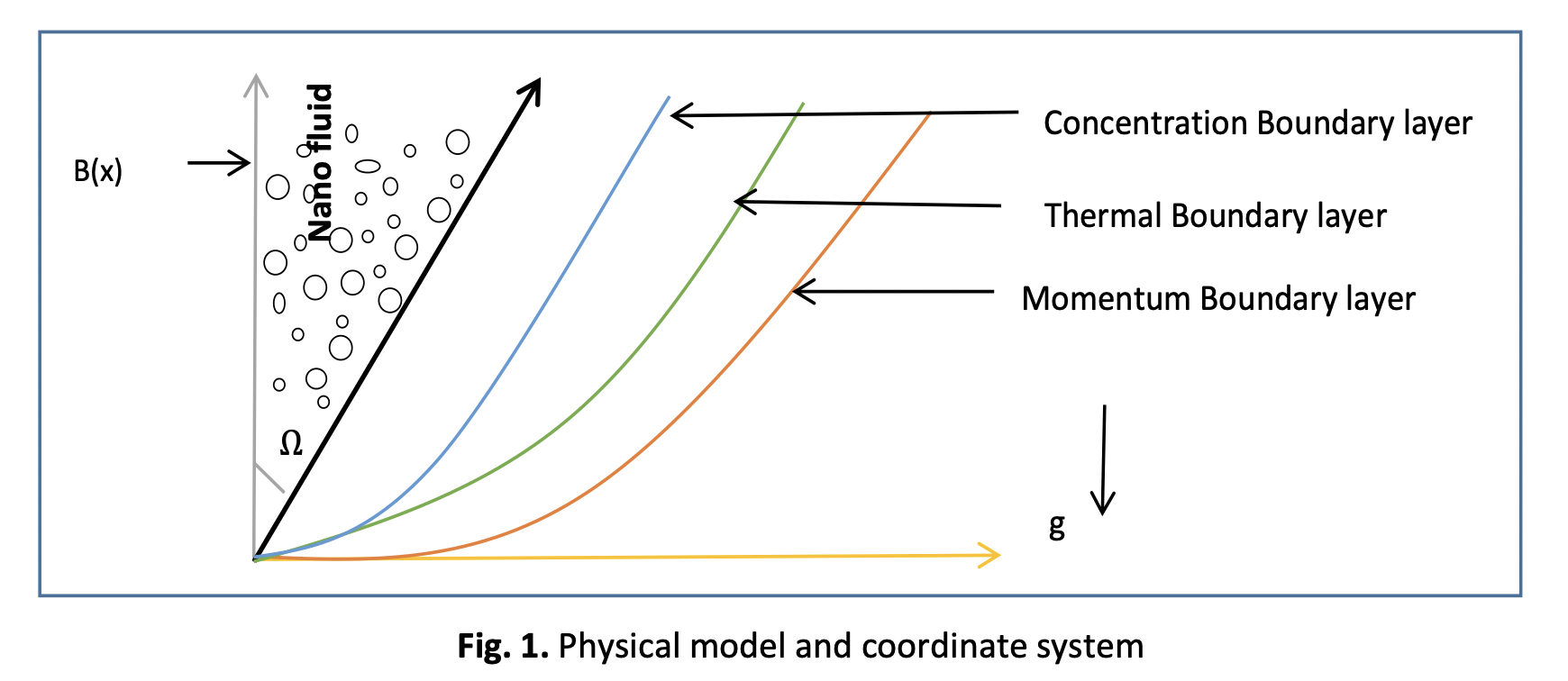
Nanofluids exhibiting high heat transmission ability are vibrant in modern-day industrial applications. As a result, scientists are always working to create more efficient mechanisms, efficient energy systems etc. Therefore a mathematical model with physical assumptions has been formulated in order to examine the energy and mass transport characteristics in a micropolar nanofluid flow. The purpose of this study is to examine the energy and mass transfer phenomenon of micropolar nanofluid flow over an exponentially stretching surface by incorporating Soret and Dufour effects. It utilizes a model based on the Buongiorno model, incorporating the effects of Brownian motion and thermophoretic forces. By introducing suitable similarity variables, the flow modeled equations are into a set of nonlinear ordinary differential equations. Numerical solutions of this flow model are obtained using the Keller box method, a reliable and widely employed approach for solving nonlinear boundary value problems. Results show that, as the radiation parameter increases, the heat transfer rate of the fluid increases, while the energy transfer rate decreases. Additionally, it is observed that the increment in Dufour effect increases the temperature distribution. Moreover, skin-friction coefficient increases with the inclination factor, whereas energy and mass transmission rate decrease